21 Aug 2026
Navigating Allocation Shifts Between High-Volatility Slot Machines and Table Games Within Regulated Gaming Jurisdictions

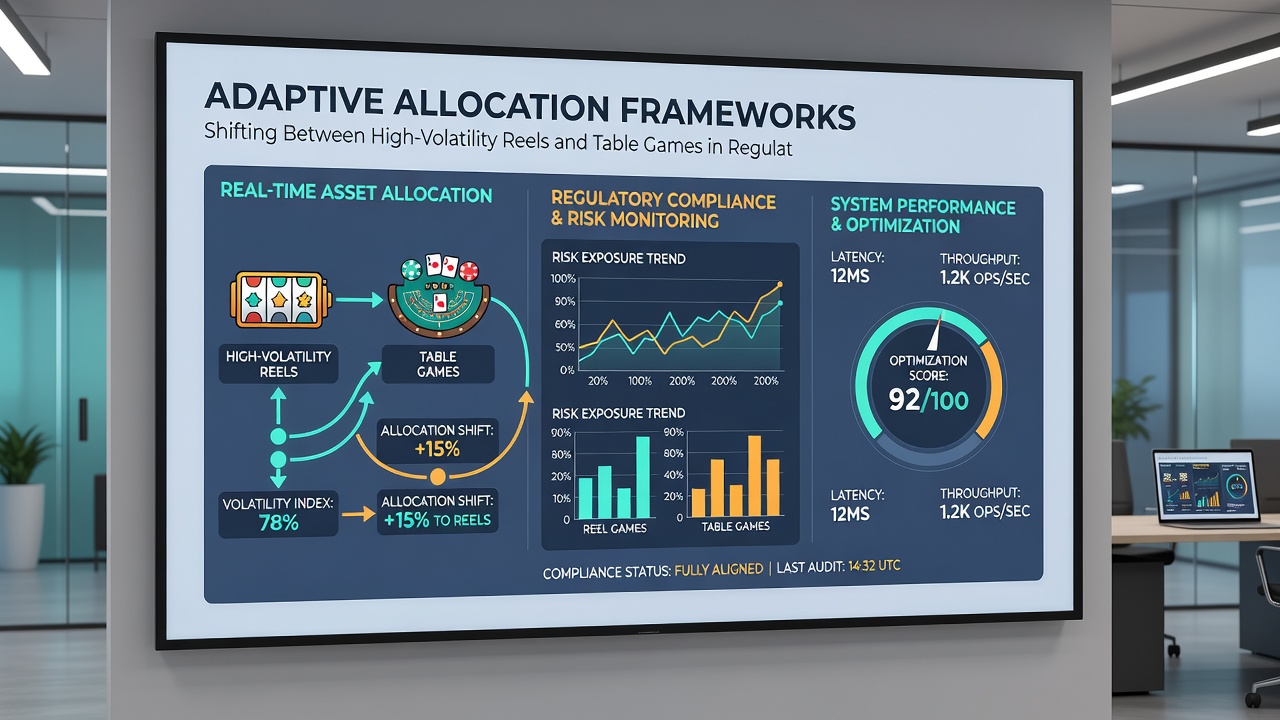
Regulated gaming jurisdictions maintain strict oversight on how operators manage player funds across different game types, and adaptive allocation frameworks provide structured methods for shifting resources between high-volatility reels and table games. These frameworks rely on predefined parameters that adjust bet sizing, session duration, and reserve levels based on volatility metrics reported by gaming control boards. Data from the Nevada Gaming Control Board shows that slot machines categorized as high-volatility accounted for 42 percent of total gaming revenue in the first half of 2026, while table games contributed 31 percent, prompting operators to refine allocation protocols that respond to these revenue distributions.
Core Components of Allocation Frameworks
Allocation frameworks incorporate volatility indices that classify reels according to payout frequency and magnitude, allowing systems to recalibrate bankroll divisions in real time. Operators integrate these indices with regulatory reporting requirements, ensuring that shifts between reel play and table action remain within approved risk thresholds. Researchers at the University of Nevada, Reno documented that platforms using automated volatility triggers reduced session overruns by 18 percent compared with manual adjustments during controlled trials conducted through mid-2026. The frameworks also embed jurisdictional caps on maximum exposure per player segment, which prevents rapid depletion of reserves when moving from low-frequency, high-payout reels to steadier table game environments.
Regulatory Requirements Across Jurisdictions
Each regulated market imposes distinct documentation standards for allocation changes. In August 2026 the New Jersey Division of Gaming Enforcement updated its quarterly reporting templates to require operators to log every automated shift between reel and table segments that exceeds 15 percent of a player's allocated bankroll. Similar measures appear in Canadian provincial frameworks, where the Alcohol and Gaming Commission of Ontario mandates pre-approval for algorithms that dynamically rebalance funds during live sessions. These rules ensure transparency while permitting operators to maintain competitive offerings that span both high-volatility reels and traditional table games.
Technical Implementation of Shifting Protocols
Modern systems link game servers to centralized allocation engines that monitor real-time variance data and execute transfers according to preset rulesets. When a player transitions from a high-volatility reel session to a table game, the engine recalculates remaining exposure limits using formulas approved by the relevant gaming authority. Figures released by the Malta Gaming Authority indicate that licensed operators employing such engines recorded a 12 percent improvement in compliance audit pass rates during the 2025-2026 fiscal year. Integration with live dealer interfaces further requires synchronization checks that confirm allocation updates occur before new wagers are accepted, reducing the potential for regulatory discrepancies.
Data-Driven Adjustments and Reporting
Operators compile datasets that track allocation performance across multiple jurisdictions, enabling periodic recalibration of framework parameters. Evidence from the Australian Communications and Media Authority reveals that multi-state operators achieved more consistent risk profiles when they aligned allocation rules with jurisdiction-specific volatility benchmarks rather than applying uniform settings. Monthly reports submitted to gaming commissions typically include variance histograms, transfer timestamps, and player segment breakdowns, all of which feed into broader industry analyses of capital efficiency. These aggregated statistics help regulators evaluate whether adaptive frameworks maintain the intended balance between player engagement on high-volatility reels and the more predictable outcomes associated with table games.
Case Examples from Licensed Markets
One operator licensed in both Nevada and New Jersey implemented a unified allocation engine in early 2026 that automatically scaled table game reserves upward whenever reel volatility readings exceeded a set threshold. Internal metrics shared with regulators showed that average player session length increased without breaching any jurisdictional loss limits. Another example from the Ontario market demonstrated how frameworks incorporating provincial tax rate differentials allowed operators to shift allocations toward table games during periods when reel taxation created higher reserve requirements. Such cases illustrate how the same core principles adapt to varying regulatory landscapes while preserving compliance across borders.
Conclusion
Adaptive allocation frameworks continue to evolve in response to updated regulatory templates and advances in volatility measurement tools. Jurisdictions maintain detailed oversight through mandatory reporting and pre-approval processes that govern how operators shift resources between high-volatility reels and table games. Data compiled by multiple gaming authorities confirm measurable improvements in compliance metrics when these frameworks operate within approved parameters. As reporting standards tighten further in 2026 and beyond, operators rely on these structured approaches to sustain compliant and efficient management of player funds across diverse game categories.