5 Aug 2026
Unpacking Payout Timing Discrepancies in Cross-State Linked Lottery Terminal Networks During Peak Holiday Periods
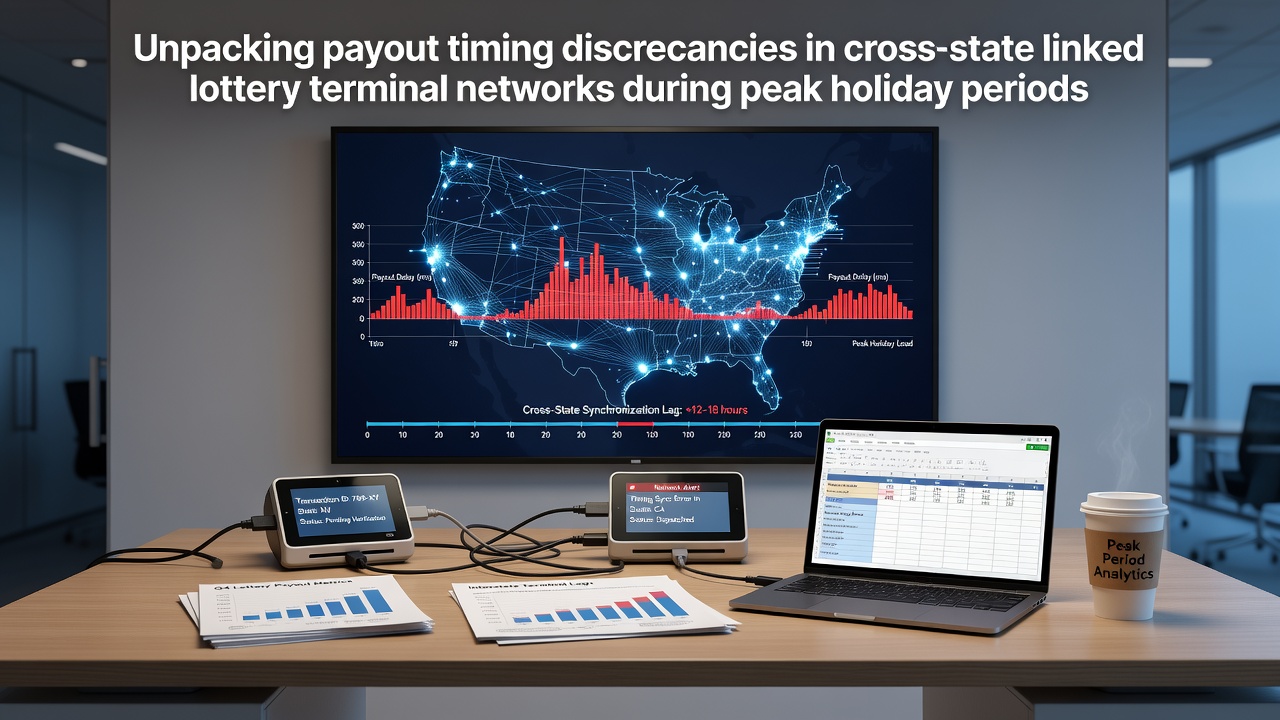
Cross-state linked lottery terminal networks connect systems in multiple jurisdictions to support shared jackpot games such as Powerball and Mega Millions, allowing players in different states to participate in teh same draws through coordinated central systems.
These networks rely on synchronized data exchanges between state lottery operators and central administrators to validate tickets, process claims, adn release winnings, yet timing differences emerge when transaction volumes spike during holiday periods like Thanksgiving, Christmas, and New Year's Eve.
Network Architecture and Data Flow
State lottery terminals transmit sales and validation data to regional hubs that feed into multi-state platforms operated by organizations such as the Multi-State Lottery Association, where draw results and prize pools update in real time across participating jurisdictions.
Each transaction passes through firewalls, encryption layers, and reconciliation servers that log timestamps at every hop, creating audit trails that reveal small variances when one state's processing queue backs up while another's clears faster.
Volume Surges During Holiday Windows
December sales records from several state lotteries show daily ticket volumes rising between 40 and 70 percent above baseline levels, with the sharpest increases occurring in the 48 hours before major holiday draws, according to figures compiled by the North American Association of State and Provincial Lotteries.
Terminal operators report that cashiers and self-service kiosks handle simultaneous purchases from multiple players, each requiring immediate validation against the central database, which stretches bandwidth and extends the interval between ticket issuance and prize-pool confirmation.
Observed Timing Discrepancies
Reports from operators in adjacent states document cases where a winning ticket sold in one jurisdiction received official validation minutes later than an identical draw processed through a neighboring state's gateway, even though both terminals connected to the same central draw engine.
These lags stem from differences in local network latency, queue prioritization rules, and occasional mismatches in how state systems timestamp high-volume batches before forwarding them upstream for final reconciliation.

Technical Factors Contributing to Delays
Packet routing paths vary because some states route traffic through dedicated lottery lines while others share commercial internet backbones that experience congestion when consumer streaming and shopping traffic also peaks, and these routing differences compound during the final hours before a major draw.
Software reconciliation scripts run at fixed intervals that do not always align across jurisdictions, so a batch of sales recorded at 11:47 p.m. in one state may wait for the next scheduled sync cycle in another before the central system registers the updated prize-pool total.
August 2026 Preparations and System Adjustments
In August 2026, several multi-state operators conducted scheduled stress tests that simulated December transaction loads, revealing that certain terminal firmware versions required updated timestamp protocols to reduce variance between state gateways by an average of 12 seconds per batch.
These tests, coordinated through the Multi-State Lottery Association, prompted participating states to adjust buffer sizes and implement priority queuing for holiday-period transactions without altering the core draw integrity checks.
Claim Processing and Player Experience
Players who purchase tickets near state borders sometimes notice that validation receipts display slightly different confirmation times depending on the terminal used, yet prize eligibility remains tied to the official draw time rather than the local validation stamp.
Customer service logs from state lotteries indicate that inquiries about delayed notifications increase during the first week of January, when holiday winners begin submitting claims and systems handle both new sales and payout verifications simultaneously.
Regulatory Oversight and Reporting
State gaming commissions require operators to submit monthly synchronization reports that flag any validation events exceeding predefined tolerance thresholds, and these filings provide the raw data used to identify patterns that recur during high-volume holiday windows.
Analysts at the North American Association of State and Provincial Lotteries compile anonymized summaries that help member lotteries compare their performance against peers, highlighting jurisdictions that consistently clear holiday batches faster due to hardware upgrades or refined routing rules.
Conclusion
Cross-state linked lottery terminal networks continue to manage rising transaction volumes during peak holiday periods by refining synchronization intervals, adjusting queue priorities, and conducting advance stress testing, while regulatory filings and industry reports document the remaining timing variances that occur when multiple state systems interact under heavy load. Data from these sources show that incremental technical adjustments reduce average discrepancies without changing the fundamental structure of shared jackpot administration.